
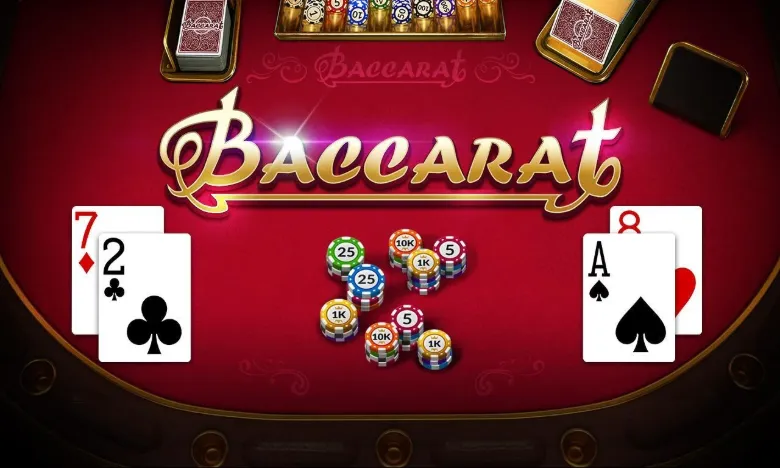
Baccarat is a game that people conquer and are passionate about due to the exciting feelings that few other titles can offer. Because you are a beginner, we will thoroughly explain the tips and rules of this 52-card game. Let’s follow along together to gain new knowledge!
What is Baccarat?
Baccarat is the French pronunciation of an Italian word, and it is also known as “bai ba cay” (three-card game) by Vietnamese players. The origins of this game have many conflicting opinions; some say it dates back to the 19th century, while others claim it goes back to the 15th century, originating from soldiers returning from the Italian wars. The three-card game became popular among French nobility in the 19th century.
Simply put, the game involves having 2 or 3 cards in your hand. You compare your cards with the dealer, and the side with the higher points wins. This game does not involve many complex strategies and relies heavily on chance.
According to tradition, this game did not have many new rules or methods, but as time went on, with the modernization of Baccarat on the internet, it gained widespread support. No matter where you are or what you are doing, you can enjoy entertainment right on your mobile phone screen. Finding leisure activities is no longer a difficult problem.

How to Play Baccarat for Beginners
Players place bets on one of two main positions: Player or Banker, or a Tie. However, the door you should avoid betting on the most is the Tie, because the probability of landing on that outcome is very low and rare. Next, female dealers draw cards one by one and reveal them all in front of everyone participating in the casino room. Two cards are opened for each side first, the total of the two cards is added up, and the score is displayed directly on the main screen.
Possible Scenarios During Gameplay:
- If the total value of the hand is 0–6, a third card is drawn right at the table.
- If the total value is 7–9, the side holding this score does not draw a third card.
Playing with Low Points
Drawing a third card should only be done when your hand is low (5 points or below). Otherwise, do not greedily take extra cards, as you might turn a winning position into a loss. That would be a great pity.
Equal Point Totals
The person with the higher score or point total wins. If both hands have equal totals, it is a Tie, and you do not lose your bet.
Important Note:
When playing Baccarat, pay attention to the values of the cards in your hand:
- The Ace (A) has a value of 1 point (never counted as 10 or 11).
- Cards from 2 to 9 retain their face value.
- Face cards (10, J, Q, K) all have a value of 0 points (or are counted as 10s where the tens digit is dropped, making them worth 0).
- A player’s score in each round is the total of 2 or 3 cards. When the total of the cards reaches a two-digit number, only the units digit counts as the final score. For example, a total of 16 means the final score is 6.
Odds and Strategies to Win Big in Baccarat
In this game, the casino (house) has a house edge of 1.24% for the Player bet and 1.06% for the Banker bet. In some places, the Banker bet incurs a 5% commission fee taken by the house, while the Tie bet pays out 8 to 1 with a house edge of around 14.4%. In the UK, casinos pay out Tie bets at a ratio of 9 to 1, giving a house edge of 4.85%.
Essential Baccarat Glossary You Need to Know
To play Baccarat fluently, players must not only understand what the game is but also know the associated terminology.
Terms for the Two Main Hands
- Player: The player’s hand. If you choose to bet on this position and win, your payout is doubled (you get your original stake back plus an equal amount in winnings). You do not pay any commission to the house.
- Banker: The casino’s hand. When you win on this bet, you must pay a 5% commission fee to the house.
Other Common Terms
- Natural: A win achieved when the first 2 cards total an 8 or 9, exempting the hand from drawing a third card.
- Tie: A tie bet when the Player and Banker hands have equal points. Payout odds range between 8 to 9 times the original stake.
- Small: A side bet based on the point spread between the two hands. If the point gap is 4, you win at odds of 1.5x.
- Big: A side bet based on the point spread between the hands, paying out 0.5x your stake if won.
- Perfect Pair: Betting that either hand will be dealt a pair of identical cards in suit and rank, paying out 25x.
- Either Pair: Betting that either the Player or Banker hand gets a pair, paying out 5x.
- Banker Pair: Betting that the Banker’s first two cards form a pair, paying out 5x.
In Baccarat, there are two primary betting positions: Player and Banker. The dealer deals cards to both hands for about 27 seconds before revealing them.

Rules for Drawing the Third Card
Several rules determine whether the player and banker stand or draw a third card. There are three main scenarios:
Natural Win
A third card is not required when the sum of the first two cards dealt equals 8 or 9. This win is called a “Natural,” an unbeatable hand. When you open the first two cards and see this result, you can rest assured you’ve won (unless a higher natural occurs). A tie is the lowest probability here and is quite rare.
Player’s Hand
When your total score on the Player hand is 6 or 7, you stand and do not draw a third card. If you want to draw more, the rules do not allow it, as every casino follows strict regulations. In physical games, rules may slightly vary according to group consensus.
Banker’s Hand
If the Banker’s total is 7, no third card is drawn. If the Banker holds a total of 0, 1, 2, 3, 4, or 5, they have the right to draw a third card (subject to specific conditional rules based on the Player’s third card).
Tactical Betting Strategies for Baccarat
Basically, the winning probability in this game is around 50/50. We have two main doors: Banker and Player. Have you ever wondered which side is better to choose?
The Banker Strategy
Even though betting on the Banker incurs a 5% commission fee for the house, statistical win rates favor it: Banker wins 50.68% vs. Player wins 49.32%. Statistically, the Banker wins more often and offers a safer bet, despite the commission fee. Although profit margins may seem small, it provides stability for long-term play.
Riding the Wave
Why is this strategy named “riding the wave”? Basically, this strategy applies historical outcome tracking to predict subsequent rounds. It sounds spontaneous and flexible, but it follows certain patterns. Below is an illustration of past casino results:
- Letter B (Red): Represents consecutive wins by the Banker.
- Letter P (Blue): Represents consecutive wins by the Player.
- Letter T (Green): Represents consecutive Tie results.
Through these results, players can clearly see consecutive winning streaks for both hands, leading to a rule of thumb: “follow the trend.” If the current round result is Banker, do not hesitate to bet on Banker in the next round. If the result is Player, immediately bet on Player.
However, everything is just probability, and probability cannot guarantee a 100% win. Baccarat probabilities are close to 50/50, so beginners should not overestimate streaks. Do not wait until you lose everything to feel regret.
Ignore the Tie Bet
Even without prior Baccarat experience, you will quickly notice that the Tie bet is the hardest to win among the three choices. Although the high payout (8x or 9x) looks attractive to beginners, winning a Tie bet is genuinely a matter of extreme luck. Betting continuously on this outcome is overly risky and not worth spending your money to test.
Have a better experience by freely playing Baccarat without overthinking. Just enjoy the game and avoid getting too deep into chance-based gambling, which can negatively impact your loved ones!
